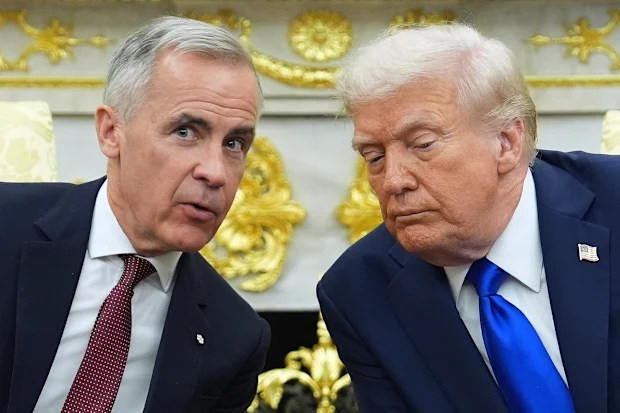
Mark Carney chatting to a person with very different values. Image credit: AP
Back in February, I finally finished Mark Carney’s chunk of a book Value(s): An Economists Guide to Everything that Matters1. The work left a remarkable impression on me because it validated a lot of the way I lean on values to succeed in my work2.
Carney, who is now the Prime Minister of Canada, is a hot commodity at the moment3. To be fair, “any well-spoken, clearly experienced at leadership, and can genuinely do the work” technocrat is a welcome contrast to some of the calamity we’re seeing in all levels of civic participation. His laser focus on values and how they can help us navigate the growing pains of an emerging new world order is landing well with people looking for relief from all the chaos.
Value(s) is centred around seven statements Carney believes are crucial for successful economies to transform global problems into opportunities, and how these values can steer decision makers through inevitable future economic crises, health crises, climate crises, and whatever end of humanity doom is borne out of the fourth industrial revolution. He also chucks in a generous pinch of history along the way4. I do wish Carney would let us peek behind the curtain of his personal journey just a little bit more given how much he has shaped the responses to so many consequential global moments.
What stood out to me the most is how Carney posits that if we really value something, but we are not willing to pay for it, then do we really value it?5
It’s certainly not an original question. But it is a good one.
I agree with Carney.
The strength of your values will always come down to time, effort, dollars, and (unfortunately) who decides where those three things go. This is especially relevant for localised community organising and civic action.
My career spans nearly twenty years. And in that time–through the heady days of swashbuckling startups to the hail Mary pitch presentations inside mega corporation board rooms to the on-the-ground community organising I lead today–I’ve been subjected to (or led) an insane volume of conversations about values. I’ve seen values come and go and enough horrible office wall art to confidently say that your values won’t stick unless you resource them6.
Most importantly, I’ve got first-hand experience on how values can successfully influence decision making. They are an essential tool in my kit when pursuing change and turning ideas into action because it’s how I achieve alignment with others (especially when tackling difficult conversations); seek clarity on the what and why; zoom out to solve problems instead of falling into tactical rabbit holes or distractions; make confident, strategic decisions; reduce how much we react to a situation; show that we are organised and prioritised when pitching to other decision makers; and just move forward versus spinning wheels7.
On the flip side, I’ve also sadly witnessed how values are easily cast aside when they don’t justify the desired outcome or solution; are only meant to achieve some vanity metric; require hard conversations about trade-offs; or have become politically inconvenient. This tends to happen a lot when people want to emulate the values of another place or entity but aren’t willing to get stuck in the nitty-gritty work of deciding how much time, money, and effort will be invested into making this possible.
Fremantle loves to draws inspiration from Europe for the kinds of values the community wants to see mirrored in our city. These desires regularly come through in my conversations with the public on practically every topic but especially around activating shop fronts, increasing cycle ridership, or reimagining public open spaces. The conflict or tension here is less about a lack of valuing the same things, but really about how much the community, decision makers, and people with the funds values what you value. You have to ask how much time, effort, and money they are willing to commit towards building the solutions that can help you achieve your values.
Again, it’s not impossible to get your community aligned around shared values. In fact, it’s a crucial skill worth developing if you’re keen to help your community turn their ideas into action. Just know that this is difficult work to conduct but it can pay off immensely if you can stick out the twists and turns you’ll have to navigate. Once you can agree on what your values are, then you can start to unpack how much they are valued, and eventually paint a realistic picture of how quickly or slowly your efforts will succeed.
- I started reading his book the week my son was born in June 2025. It’s taken a few more months for the information to marinate inside my head and form my reflection. This is a big book for wonks by a huge wonk. ↩︎
- 1 set of values I have are: practice, patience, & perseverance. Another set: be responsive and relevant; go to the community and meet where they meet; be visible and accessible; conduct quality conversations. Blog post on these to follow, of course! ↩︎
- The Davos speech is how most people outside of Canadian politics or central banking fandom would’ve been introduced to him: https://www.youtube.com/watch?v=izDAOvHz5Wc. ↩︎
- They are: dynamism, resilience, sustainability, fairness, responsibility, solidarity, and humility. More detail here: https://www.good-governance.org.uk/assets/uploads/publication-documents/Books/Values-the-future-of-governance-and-society-GGI-book-review-July-2021.pdf ↩︎
- Full credit to Colin Finkle for such a sharp summation: https://colinfinkle.com/review-of-values-by-mark-carney/. ↩︎
- I even co-wrote an article about it for Harvard Business Review: https://hbr.org/2016/07/dont-let-your-company-culture-just-happen. ↩︎
- For more nuggets, see my post: What I tell community groups that are stuck or just starting out ↩︎
